
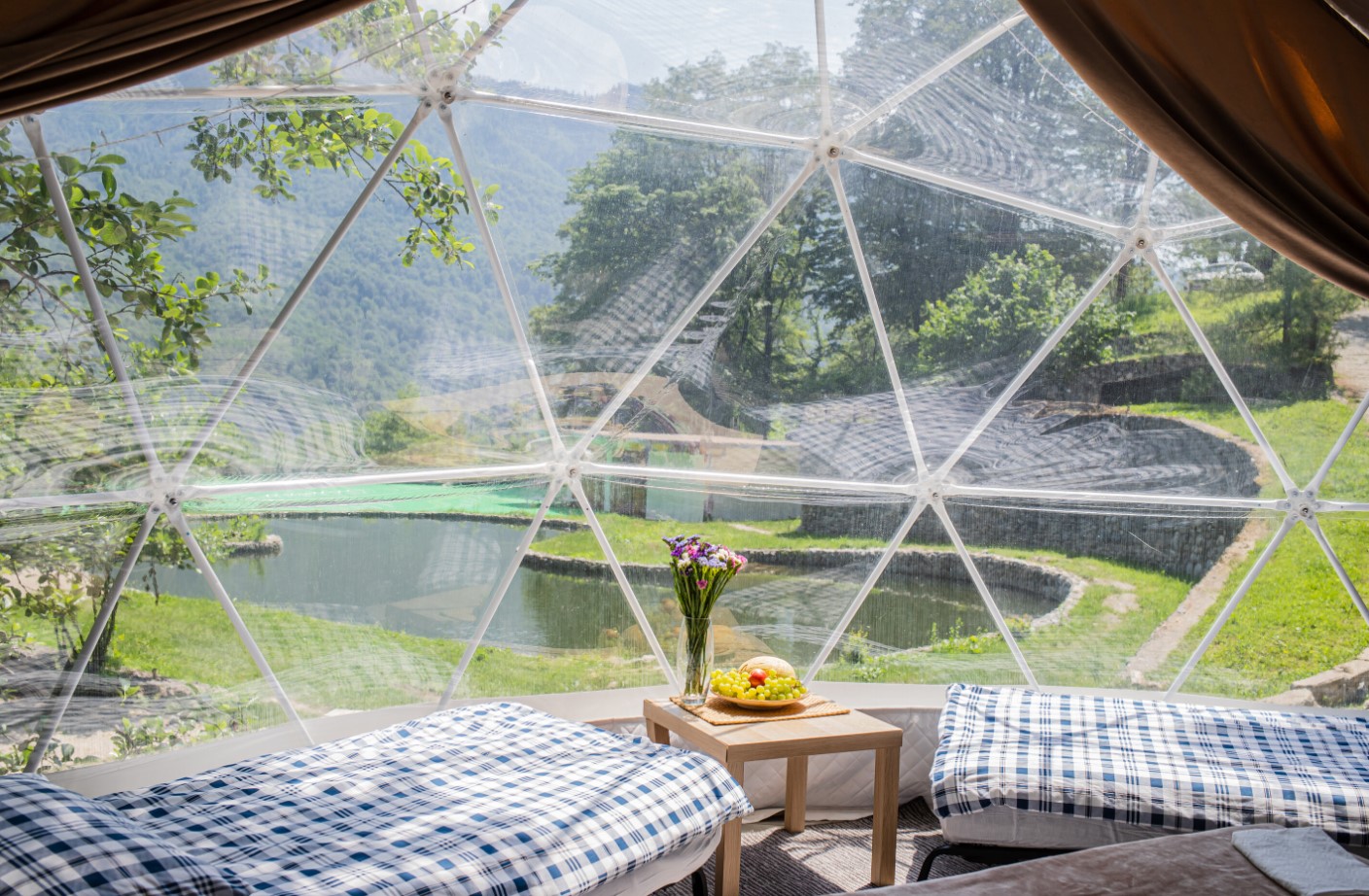
Glamping is a type of camping that combines the comfort of a hotel room with the opportunity to relax in nature. In fact, this is a synergy of several businesses, when the room stock is combined with “points of attraction” in the form of spa complexes, restaurants, etc.
At the same time, the profitability of eco-hotels greatly exceeds what other development businesses can offer. A conditional “comfortable tent” can be rented out. While apartments of the same price segment (4-5 stars) have an average payback period of about 20 years.
Usually, glamping creators are guided by the beauty of the land plot, its location, but the selection criteria should be different. For example, out of more than 2,000 viewed land plots, no more than thirty passed our inspection. The main task of the organizers of such projects is to build an object and start paying it off quickly, preferably in three years. Therefore, now the most common offer on the market is glampings built on leased plots and often on agricultural lands, national parks, forest reserves, where nothing capital can be built.
The implementation scheme for such projects is simple: an entrepreneur applies to local government bodies (urban planning or architectural department) with a request to issue a permit for non-capital construction. The department refuses, notifying that if the structure is non-capital and does not have a strong connection to the land, then there is no need to obtain permits.
But no one tells the department that there will be 20 such buildings on the land plot and they will be rented out as a hotel complex and offered to investors with a promise of a share and profit.
Subsequently, the administration has questions about the use of this complex, courts begin and the case often ends up demolishing. Now, courts and demolitions have not yet entered the public arena, but soon we will be covered by a real wave of such proceedings.
1. They conclude a lease agreement for a land plot. But in the overwhelming majority of cases, this land is not suitable for running a business in the form of a glamping or hotel.
2. They receive a refusal in the permit documentation indicating that their building is not a capital one, which means that a building permit is not required.
3. They offer investors to buy a non-capital building, not registered on this leased plot, in whole or in shares under an agency agreement or with a mortgage.
4. They offer to take this object under management and together receive rental income.
The logic of the project implementers is as follows: the plot is leased, if a trial begins, then all questions are addressed to the owner of the plot, and not to those who leased it. The owner of the land receives rent, and if the administration makes claims, then he will ask to move or demolish the buildings. So the only one who ends up being the scapegoat is the investor who bought a non-capital frame building or a tent under an agency agreement.

If the land on which the glamping site is located is rented, further communication can be stopped: a private landlord can change his mind at any time, and contracts with the national park and forest fund often prohibit commercial activities. How it should be: there is a certain legal entity, on whose balance sheet and in whose ownership is the land and all the buildings located on it. At the same time, the share of each owner of the asset within this legal entity is constantly growing, and he can dispose of it as he wants. That is, the complex is in the hands of those who are interested in its development.
Glamping is always a search for compromise solutions, a search for the right combinations of land and what is being implemented on it. All this requires knowledge, competence and flexibility. Therefore, the team must be from the world of construction. People with construction experience, insight, and most importantly - a powerful general contracting structure. In the world of glampings, there are only a few such companies, usually a team-based construction method is used: several teams, loosely connected to each other, a huge number of contractors (some have drawn, others are thinking about how to build it, others are pulling the electrics, others are doing the finishing, and the organizers go to the construction market to buy more nails). All this does not have the best effect on the timing, budget and, as a result, operation. So only companies that have their own architectural bureau, design department, centralized supply department, design and estimate department responsible for the quality and timing of construction, etc. can guarantee a good result. There must be a clear monetization strategy. It is important for the investor to understand how the facility makes money, what vacation scenarios it offers. For example, we believe that the generally accepted concept of "target audience" as applied to this area is completely flawed. It is more correct to focus on the holiday scenario, because the client can come alone in search of privacy, or with his girlfriend, with his family and child, with parents or colleagues, for a birthday or wedding, etc. These will be different holiday scenarios, but with the same specific client. Therefore, it is important that the complex is designed taking into account the comfortable operation of all these holiday scenarios. In a tent with an area of 24 square meters or in a "frame house" without space for things, most of the scenarios are simply impossible.
There should be a clear status of the investor (for example, a co-owner with the right to receive profit) and an easy exit from the project. As for the exit, everything is simple: this is when everything is arranged in such a way that the asset can be sold at any time, which is facilitated by (summarizing all of the above):
capital buildings with cadastral numbers and the ability to insure them;
type of permitted use of the land plot, suitable for that which will be carried out on this site
not a typical, but original and unique architecture. Houses for year-round living (not tents without heating).
construction team, popular location and transparent figures.
If these conditions are met, the business can bring in a stable income, which will be much higher than, for example, an apartment. Our experience is the clearest confirmation of this.
The article helped me a lot in developing my business. The authors tried to reveal the very essence of the issue of financial activity. More information could have been added.
Thank you for the explanations on finances and strengthening the business. Much in this area remained unclear, but I hope that the authors will continue to delight us with useful articles.
Everything is written very concisely and clearly. The article helped me understand some issues related to finances and their management. I am waiting for the next issue of useful information.
7850, Church St, Millington, TN 38053
+1 (901) 873-5520
contact@vegijaha.de